
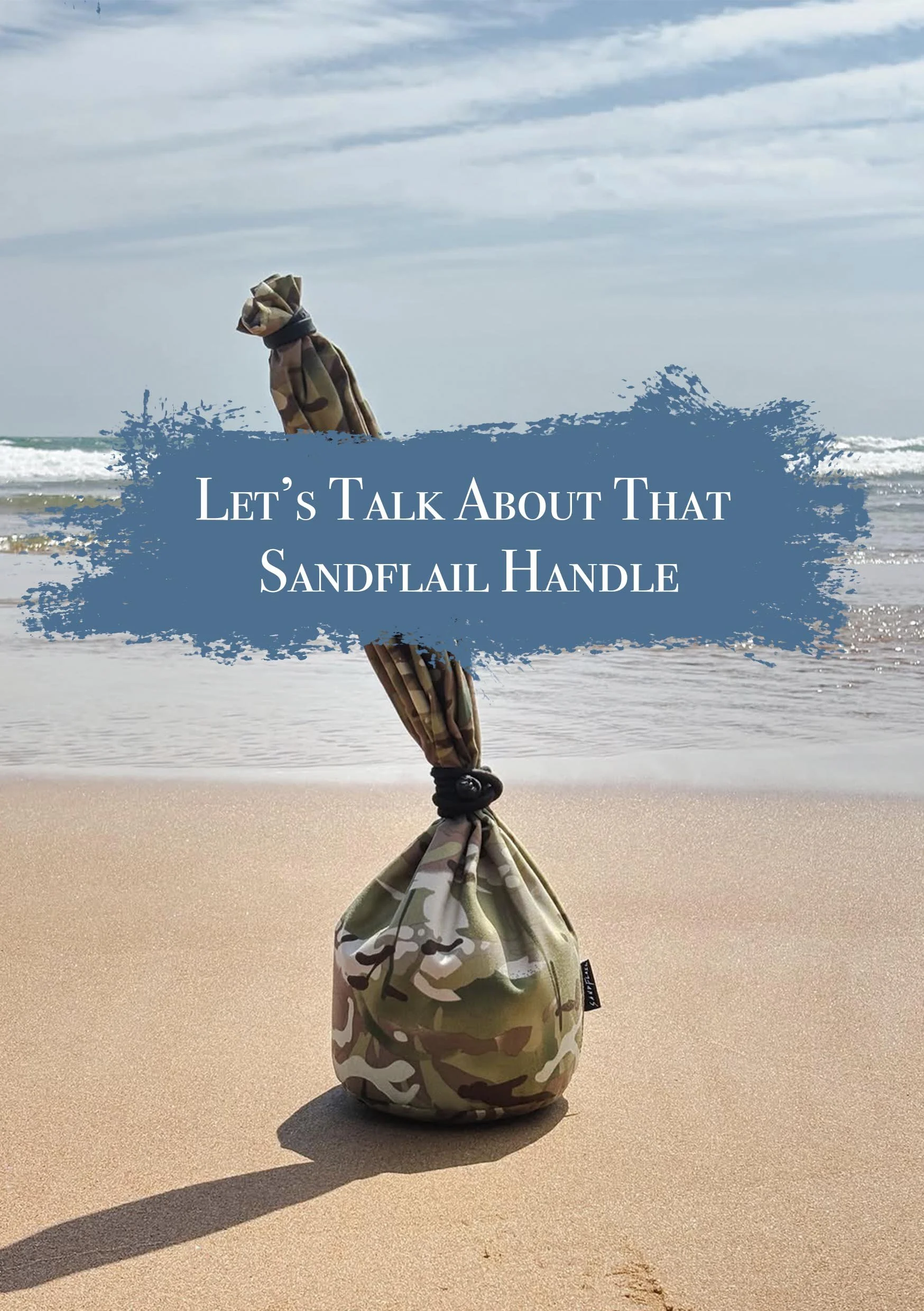
Difference between The Sandflail flexible handle and other tools with solid handles.
The difference comes down to how the tool transfers force and how your body controls it.
A solid-handle mace or club is essentially one rigid lever. A sandflail Introduces a moving joint between your hand and the weighted head, which changes the dynamics significantly.
Here's what the flexible handle accomplishes:
1. It delays the force transfer
With a rigid mace, when you move the handle, the head moves immediately because they're locked together.
With a flexible handle:
Your hand starts moving first.
The flexible section bends.
The weighted head lags behind before catching up.
This creates a "whip" effect where the force arrives later rather than all at once.
2. It forces constant stabilisation
Because the head isn't rigidly attached, it wants to continue moving under its own momentum.
Your:
wrists,
forearms,
shoulders,
core,
must make continuous small adjustments to keep it under control.
A rigid mace is comparatively predictable.
3. It increases proprioception
You receive much richer feedback through the flexible connection.
You can actually feel:
where the head is,
when it's accelerating,
when it's pulling away,
when it's beginning to swing off-axis.
Many people describe this as the tool "talking back."
4. It smooths the acceleration
Instead of a sudden stop or reversal at the end of a swing, the flexible connection absorbs part of that change.
The result often feels:
less jarring,
more fluid,
more circular.
That's one reason many people enjoy using them for flowing movement drills.
5. It punishes poor timing
If your timing is off:
the head swings wide,
oscillates,
or pulls you out of position.
A rigid mace can often be "muscled" through a movement.
A flexible tool requires you to coordinate:
body rotation,
arm motion,
and rhythm.
6. It changes loading during swings
During circular movements, the head develops centrifugal force.
With a rigid handle, that force is transmitted directly.
With a flexible connection, the direction of pull is constantly changing as the handle bends, so the load on your muscles is less constant and more dynamic.
Why it feels "alive"
Many users describe flails as feeling alive because the weighted head has a degree of independence. Your nervous system is continuously predicting and correcting for its motion. This is similar to handling:
a rope with a weight attached,
a kettlebell during certain ballistic movements,
or a medicine ball on a tether.
The flexibility means you're managing an object with its own momentum rather than simply rotating a rigid implement.
Summary
A flexible handle primarily:
delays and smooths force transmission,
creates a whip-like motion,
requires much greater stabilization,
improves proprioceptive feedback,
rewards precise timing and rhythm,
and makes the implement feel dynamic rather than rigid.
That's why swinging a sandflail often feels less like lifting a club and more like guiding a moving mass that has its own momentum. A completely unique experience unlike anything else.